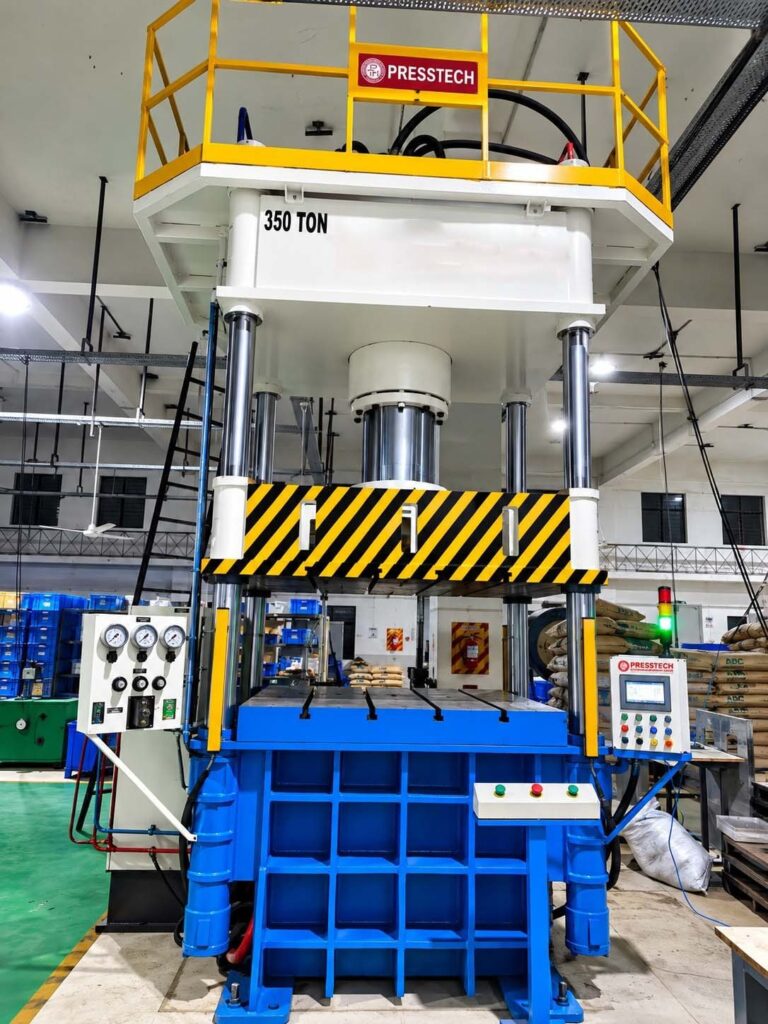
“Precision begins with a press that is built to handle the job with confidence.”
Not every hydraulic press is built to handle a job in the same way. The frame structure, pressing area, force distribution, control system, and working arrangement can all influence how a machine performs during production. A four pillar hydraulic press uses four vertical columns to support and guide the moving platen, giving the machine a distinct structural arrangement compared with other press designs. This configuration can be used across different forming, moulding, pressing, and industrial applications depending on the machine specifications. In this blog, we will explore what makes a four-pillar hydraulic press different from other presses, how its structure works, and which features can matter when selecting a machine. For businesses comparing a four pillar hydraulic press in Chennai, understanding these practical differences can make equipment selection more informed.
One of the major features of this type of hydraulic press is its four pillar design. During pressing, the platen moves on four vertical columns that support the machine frame. This works well for providing a structure to work on and is good for the press to perform various production tasks in accordance with its size and specifications.
The structure includes:
The platen on the press moves towards the workpiece or mould during the pressing operation. This movement is powered by hydraulic pressure acting on the cylinder system, enabling the machine to exert a controlled force on the material. The motion must stay even and on target for the whole cycle.
The travel distance and operating speed may vary depending on the design of the machine and production requirements. The efficiency of the press to undertake different jobs can be affected by these factors.
Platen movement depends on:
If a press is used for a wide working area, force distribution is a consideration. The four pillar arrangement lifts the platen around several points, aiding in the maintenance of its position under hydraulic pressure. Achieving consistent pressing performance is related to the proper machine design and alignment.
Balanced operation may prove very beneficial for bigger moulds or parts where the uniformity of the force applied is important to the process.
Balanced operation may be achieved through:
The processing capacity is different, and a hydraulic press can be adapted to different moulds used in the process. What size of mould can fit inside will be determined by available table dimensions, daylight, stroke and overall press capacity. When choosing a machine, it is important to consider the actual mould requirements to prevent space or clearance restrictions.
The mould must also be placed appropriately in the working area to allow the pressing operation to be performed safely and repeatably.
The compatibility of moulds depends on:
Hydraulic systems enable the force and motion applied to the work to be directed and regulated as needed. During the press production, the pressure setting, cylinder movement, stroke and cycle controls may affect the operation of the press. By taking care of these troubles, operators can achieve more repeatable similar pressing cycles.
The control system will vary depending on the machine and in some cases may require more automation and adjustment than others, depending on the application.
Control features could consist of:
The manner in which materials are loaded into and ejected from the press can impact the workflow. The layout of a working area should allow operators enough access to place moulds, components and to move out finished parts. This is particularly important for larger or heavier workpieces.
Thus, accessibility must be taken into account in addition to machine capacity. A press that will fit a component might not be easy to use if there isn’t a usable working area.
Loading considerations include:
“The right press brings together strength, stability, and control in one working system.”
The capacity of the press should be commensurate to the nature and size of work being done. It is very important to select a machine based on the maximum tonnage, but also consider the table size, stroke, daylight, and control features. Therefore, it is advisable to check the full machine specification before buying.
The amount of force required for different production tasks will vary, so it is important to know the actual pressing requirement when selecting equipment.
Capacity should consider:
A hydraulic press becomes truly useful when its design and specifications match the work it is expected to perform. The four pillar structure, platen movement, force distribution, mould space, pressure control, and machine capacity all play a role in how the press handles different production requirements. Rather than choosing a machine only by its tonnage or appearance, businesses can compare the complete working specifications and consider how the equipment will fit into their production process. Exploring suitable options from experienced Four Pillar Hydraulic Press in Chennai suppliers can help manufacturers understand the available configurations and select a machine that fits their application, workspace, and future production needs.
©2026Presstech Systems India Pvt. Ltd. All rights reserved. Design and Developed By