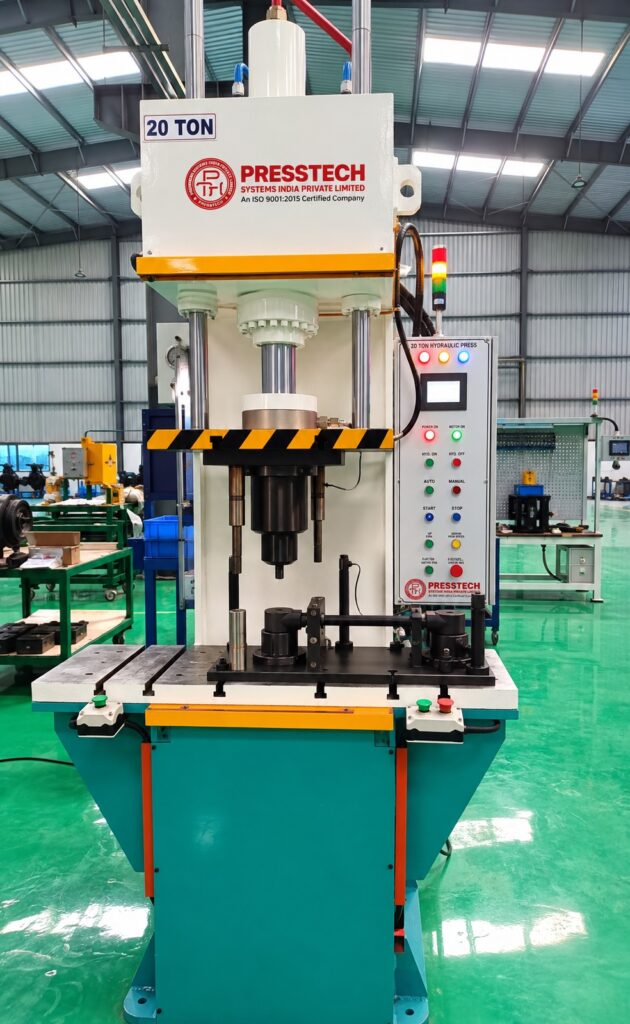
A hydraulic press serves as vital equipment in many industrial processes, such as bending, punching, forming, straightening, pressing and assembling. In general, the C-frame hydraulic press is widely used due to its small structure, ease of access to the working area and its adaptability in various production work among the various designs available in the market. The purchase of a hydraulic press isn’t just about specifying a machine that has a certain tonnage, however. It really depends on the kind of work, materials, quantity of production, space requirements, safety requirements and life expectancy and maintenance. Without considering these factors, a machine may end up costing the customer more to operate than it is worth, or they may not be able to achieve the production.
Let’s dive into this blog to explore the essential things to know before buying a C-frame hydraulic press in Chennai.
“The right hydraulic press is not just a machine; it is an investment in precision, productivity, and performance.”
The name C-Frame Hydraulic Press comes from the C-frame, which encircles the work area. The open-sided configuration makes it simple for the operator to reach the workpiece from the front and the side, and helps them to put the workpiece in place and take it out. The C-frame design offers a significant benefit in terms of easy accessibility. Generally, the operators can manipulate the components more easily with some enclosed press designs.
This can be beneficial in workshops where flexibility and quick handling are significant. Before ordering, it is essential to determine if the machine’s working area and frame opening is appropriate for the desired components to be processed. The machine uses hydraulic pressure to generate controlled force through a cylinder and ram. Depending on the design of the press, it can be used for operations like:
Capacity to press is one of the initial designations that you need to take into account. It’s usually measured in tonnes and represents the force the hydraulic press can exert under pressure. Depending on the use, a required capacity varies as a multiple of the unit. A press which is used for light assembly work will not require the same tonnage as is needed for heavy-duty forming or punching.
To calculate capacity, take into account:
It is generally better to understand the actual force requirements rather than selecting a machine simply because it has a higher tonnage. If the machine is too large, it will result in overinvestment, high energy use and excess space. Meanwhile, if you choose an oversized press, it may end up stressing out the press and negatively affecting the press performance. A discussion with the manufacturer can be helpful when determining the actual application to come up with the right capacity.
The machine tonnage of a C-frame hydraulic press is a key factor, but not the only element to consider when assessing if it would work for your application. The working physical area should be considered also. When considering buying a table, take a look at its size, daylight, throat depth, stroke length and the entire dimensions of the machine before buying. One of the unique features of the throat depth in a C-frame press is its capacity to press a workpiece up to a certain depth on one end of the machine.
If you tend to use the machine for larger parts, the short throat might hamper the machine’s usefulness. Also take into account the size or dimensions of the working surface. The components are not to be overtightened, so that they can be put in place easily without interfering with the frame and other machine parts. Take into consideration the space you have on the floor in your workshop. Provide adequate clearances from the machine for material handling, maintenance, the machine operator and safe operation.
The hydraulic system directly affects the performance, consistency, and reliability of a C-frame hydraulic press. Before purchasing, check:
Hydraulic Pump: Check the pump quality, pressure capacity, and expected operating life.
Hydraulic Cylinder: Ensure the cylinder can deliver the required force and smooth movement for your application.
Pressure Control: Look for accurate pressure adjustment to maintain consistent pressing force.
Valves: Reliable hydraulic valves help control the speed, pressure, and movement of the ram.
Oil Filtration: A proper filtration system helps keep hydraulic oil clean and protects internal components.
Ram Movement: Check whether the ram provides smooth and controlled movement without unnecessary vibration.
Control Panel: Choose controls that are simple for operators to understand and use.
Stroke Adjustment: Adjustable stroke settings can be useful when different components require different pressing depths.
Hydraulic presses generate substantial force, so safety should be considered before purchasing rather than after installation. It needs to be equipped with the necessary safety devices for the machine to operate properly and meet all relevant industrial safety standards. Protection for the operator and two-hand controls, suitable pressure control, and pressure protection, emergency stop controls, movable areas that are guarded, and safety switches allow useful safety features to be included with these machines depending on the configuration.
Also, having the machine in question set up in the right manner is significant. Operators must get to the work area without having to avoid working around moving components. Enquire with the manufacturer what precautions they have taken and the standards they used for developing the machine. Proper installation and operator training are also of importance, as even a well-designed press requires proper use. A machine that operates easily, is self-explanatory and has the necessary safety devices can help to make the working environment safer.
Price is naturally an important part of any industrial equipment purchase, but the lowest initial price does not always represent the lowest overall cost. When selecting a C Frame Hydraulic Press, be sure to take the total cost of ownership into account. This encompasses the purchase price, installation costs, electricity usage, hydraulic oil, spare parts and maintenance costs as well as possible downtime. A reliable machine could be able to give more consistent performance over time.
However, frequent breakdowns or the inability to get parts to replace them could impact production programs. Valuable aid can be found in the technical support offered at the local level as well. Access to expert service staff helps minimise downtime in the event of a problem. Focusing solely on the purchase price of a machine when evaluating different suppliers is not the best way to measure value.
Enquire about the supplier:
“A reliable hydraulic press turns demanding industrial tasks into controlled and repeatable processes.”
This is why selecting the right manufacturer to make your machine is crucial, since it should correspond to the production requirements that you have. If you’re considering buying something, take into consideration:
Application Knowledge: Select a manufacturer that has knowledge about the application needs related to pressing, bending, punching and forming.
Customisation Options: Check whether the manufacturer can modify the machine based on your component size, force requirements, or production process.
Knowledge of Machine Specifications: Understand key parameters including tonnage, stroke, throat depth, table size and operating speed.
Build Quality: Ask about the quality of the frame, hydraulic components, electrical systems, and other major parts.
Installation Support: Ensure that the manufacturer supplies suitable installation and commissioning support.
Operator Training: Training can help operators understand the machine controls, safety procedures, and basic maintenance.
Warranty: Clearly understand the warranty period and which components or services are covered.
Spare Parts Availability: Ensure that spare parts are in stock to prevent unnecessary manufacturing downtime.
After-sales service: When maintenance or troubleshooting is needed, reliable technical support can be helpful.
When purchasing a C Frame Hydraulic Press in Chennai, consider not just capacity or cost, but others, too. The machine should perform the functions for your application, materials, size, production runs, workspace and working environment. One basic step towards the issue is to first understand the level of force needed; and second to assess the proper working area, throat depth, stroke, hydraulic system, controls, safety considerations, maintenance, and service support. Belonging to a long-term approach, although you keep an eye on buying a new deck, also take into account the operating costs for the long term.
©2026Presstech Systems India Pvt. Ltd. All rights reserved. Design and Developed By